
A description is given of the Tower and its surrounding estate in George Poulson’s 1841 book The History and Antiquities of the Seigniory of Holderness, in the East Riding of the County of York. The length and complication of that title is indicative of the state of the prose throughout. It is written with the grammar and punctuation style of the Victorian period, and quotes extensively from much older sources, with a great many abbreviations, archaic keywords and compound sentences. Below is copied the section relevant to this project, extending from page 488 to page 493.
PAUL HOLME – Holme is returned in Domesday as a Soke of one carucate, belonging to Brocstewic. Circiter, 30 H. II. William de Mandeville, Earl of Essex, grants to Walter Camerario, and heirs, to be held of the said William and his heirs, 20 acres of land, supra montem, and tofts and closes of such, by knight service, as much as belongs to the third part of half a carucate, where 48 make a knight’s fee; tested by Simon Belle Campo, William de Dringham, Robert de Ulram, Ingram de Monceaux.*
The family of Holme having possessed this place, from whence they derive their name, from a very early period, the following descent is best calculated to point out their connection with it:-
[There then follows a lengthy family tree.]
There were several antient landholders in this place besides the Lords of the manor, and when such occur in the several lordships, they are arranged in this History under
PREMISES OF LESS NOTE. – Fulco de Oyry bought in Paul Holme. Temp. H. III. Walter de Sceller, of Paulfleet, held here at his death, in his demesne as of fee, 4 oxgangs of arable, 11 acres of meadow and pasture, for nine gross animals, of the King in capite, as of the hon. of Alb., by the service of finding four men at Paulfleet, for conveying across the Humber the lord and lady of Holderness, for the time being, whenever it shall happen that they shall go from thence to Lindsey.** He held also, as above, de Rege. in capite, of the hon. aforesaid, a mess. and 4 tofts and a half, and pasture for one gross animal, 8s. 6d., cum perts in Paulfleet, by the service of paying to the king’s manor of Burstwick, 2s. 11.75d. for all service. E. I. Robert, son of Robert Peacock, quit claims to Alexander de Holme, pasture for 20 sheep, and 12 acres of common pasture, in Villa de Holme, viz. the pasture which Thomas le Ohen, late Lord of Holme, gave to Robert Peacock, his father; tested by Wm. ad Cameram, Wm. ad Grange, &c. – [Orig. B. C. Lib] 10 E. I. Robert, son of Robert Peacock de Holme, grants to Alexander Holme, and his heirs, two acres of land in Holme field; tested by Stephen de Paul, Rob., Wm., and Alram de Clauso, in Holme, brothers &c. Circa 30 E. I. Izabel, widow of Alan le Veyle, of Catwick, sister and heir of Philip Peacock, gives to Alexander Holme, lands here; tested by Wm. Gumband, Wm. de Holme. – [Meaux Chart.] 3 E. II. Alexander, son of John, relict of Alexander Holme, was ward in custody of Walter de Haytfield, of Preston, as appears from a deed dated by Walter, at Sigglesthorn; 3 E. II. 1309. 4 E. II. Wm. de la Chambre held here a mess. 2 parts of 2 oxgangs of land in Holme, near Paul, of the King, as of the hon. of Alb., doing suit at the Wapentake Court of Holderness every three weeks. 11 E. II. Willm., son of John ad Cameram, of Holme, gave relief for his patrimony in Paul Holme.*** 14 E. II. Laurence Holbeck, held of the King in Holme, a moiety of a messuage, and the 14th of an oxgang of land, of the King in capite, as of the hon. of Alb., by military service.^ 20 E. II. Henry le Chamberlayne held 1 mess. 1 toft, 1 bovate, 12 acres, and 1 rood of arable, and 3 acres of meadow, in Thornton, in Pickering Lythe, of the King in capite, as of the hon of Alb., by the service if the 40th part of a knts. fee^^ 11 E. III. Robt. le Constable, of Halsham, and Burton Constable, inter alia, held here 2 tofts 26.5 acres, and pasture for 11 gross animals, and a rent of 78s. and 10d. in Paulholme, by the service of 6.5d. for all services.^^^ 13 E. III. Simone, son of Alexr. Holme. gives to Alexander his brother a toft, lying in the vill of Holme, near Paul; tested by Sir Walter, Vicar of Paul, Wm. Coco, of Holme; given at Holme, St. Botolph’s day, 1338. 18 R. II. Beatrix, wife of Wm. Chambers, held in Holme a mess. and 2 parts of 2 bovates of land, &c.**^
Of the Chapel of Paul Holme, returned as dilapidated in the reign of Queen Anne, no vestiges are now left. John Holme, of Paul Holme, Esq., by w. d. 23 September 1438, bequeathed two torches to burn in the chapel of Paul Holme. Robert Holme, of Paul Holme, by w. d. 1 August 1503, 19 H. VII., directs that a priest shall celebrate in the chapel of Paulholme, during his wife’s life, and after her death for twenty years successively, for the good of their souls.
The Old Manion, or Manor House appears from tracing the foundations, to have been built in the form of the letter H; one of the towers is still standing, and has been the north wing of a castellated house. It is about 30 feet high, with battlements and small loophole windows on each side; the east side is now nearly covered with ivy. On the west front of the tower – Holme, impaling Wastney, are quartered on a stone in the wall, still in good preservation; the building must have been erected after the marriage of the Wastneys, (see ped.) Arms of Holme, of Paul Holme: – Barry of six pieces, or and azure, on a canton a chaplet, gules, studded with four cinquefoils of the first. Wastney: – Sable, a lion rampant. There are roses in the corners of the stone, indicating perhaps that the building was erected in the reign of H. VII. The house stood in a low situation, close to the foot of the Holme Hill, and the tower is isolated in a field; the hill is probably one hundred feet high, a considerable elevation for Holderness, upon which an artificial mound seems to have been raised, in an oval shape, to which tradition has assigned an observatory, for the purposes of communication with Thornton Abbey, in Lincolnshire. A new house was built in 1837, out of the materials of the old one, contiguous to it,*^^ but the tower, or cell as it is termed, is left standing.
The manor of Paul Holme extends over Boreas Hill, and Austere Grange in Thorngumbald, a farm of about 60 acres belonging to Mr. Prickett. The Rev. H. J. Holme is Lord of the manor, except about 7 acres, which is in the Paghill division.
Little Humber. – The monks of St. Martin’s, Albermarle, 18 R. II. conveyed, inter alia, all their lands which they held here to the monks of Kirkstall. It contains a farm called Oxgoads or Osgoddes, about 500 acres*^* the whole the property of Sir Clifford Constable.
Thorney Crofts, another property in this parish of about 170 acres of land, was sold by the Constable family. The Stovins re-sold it to the late Mr. Brigham, of Bilton, who left it by will to Mr. Godfrey Park, of Catwick, near Rise.
*Orig. penes nuper H. Holme.
**William le Gross gave the Abbey of Meaux a free passage at Paul, but which was afterwards regranted by them to Robert, son of Benedict. In the fifth year of E. II. the king issues an order to the keepers of the manor of Burstwick, that they should cause a new vessel to be built for the purpose of making the passage between Paulfleet and Skitterne Mill. – [Cl. Ac. 5 E. II. m. 4.] This shews the point at which this ferry landed their passengers; and it would appear the Lords of Holderness made Paul the place of embarkation, from its proximity to Burstwick, thereby avoiding Hull in their progress into Lincolnshire, and to Thornton Abbey.
***Abst. Hold. Rec ^Eschts. 14 E. II. 132, No. 40. ^^Harl. 708, Fo. 143. ^^^Burt. MS. 3 vol
**^Burton’s MS. 5 vol. *^^Occupied by Mr. Benj. Iveson, tenant of Mr. Holme, who kindly sent communications of use to the author. *^*Mon. Angl. vol I, p. 489
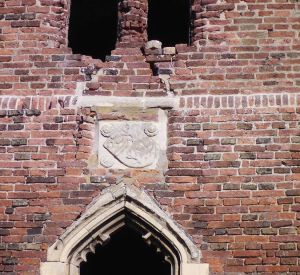 On the western front of the tower, immediately above the pointed arch of the first floor’s window, is a stone square into which is carved a shield of arms, which is leaning to the left and surrounded by three roses.
 Paull Holme Tower