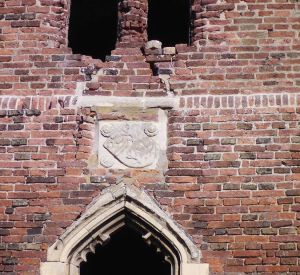
 On the western front of the tower, immediately above the pointed arch of the first floor’s window, is a stone square into which is carved a shield of arms, which is leaning to the left and surrounded by three roses.
These are clearly the arms of the Holme-Wastneys, who owned and lived in the tower for many centuries. They can also be seen in the Holme family painting between the heads of the husband and wife.
Burke’s Peerage General Armory (page 502) gives many entries for the surname Holme, but this one is the most explicit:
Holme (Paull Holme, co. York, temp. Conquest). Barry of six or and az. on a canton ar. a chaplet gu. Crests-1st: A holly tree fructed ppr.; 2nd (granted to Sir BRYAN HOLME, of Paull Holme, in 1346, on the taking of the King of the Scots prisoner): Out of a mural coronet gu. a hound’s head erased or. Motto – Holme semper viret.
The note about the second crest presumably refers to the Battle of Neville’s Cross, at which David II of Scotland was captured, to be kept in England for eleven years until a ransom was paid. Thus far I have found no particular reference to Sir Bryan Holme, no explanation for the significance of the hound’s head.
The granting of a second crest is an example of Augmentation of arms. Another, quite similar, example is Thomas Howard, 2nd Duke of Norfolk, who for his victory at Flodden was allowed to add to his own shield a small copy of the Scottish royal arms, except with an arrow going through the red lion’s mouth.

Curiously the book has no reference for the Wastney arms, but by observation they are some variation on Sable a lion rampant Argent. The use of quartering indicates that at some point in the early history of the tower a man from the Holme family married a woman from the Wastney family whose father went on to die without legitimate sons (or whose legitimate sons’ own legitimate descendants eventually became extinct) thus making her an heraldic heiress.
Many examples of the Holme and Wastney arms (including the hound crest) can be seen in other places in the region.
The roses are, of course, royal livery badges. The livery badges are a para-heraldic device used for situations where the use of crest or shield would not be appropriate. Generally speaking an armigerous person and his agnatic family would wear surcoats repeating the designs on their shield, while their servants and political supporters (whether or not armigerous themselves) would wear the badge. The fifteenth century saw England rocked by civil wars due to disputes over the succession to the crown between the Houses of York and Lancaster. These have come to be known as the Wars of the Roses due to the use of roses as badges of the major factions – a white rose for York and a red rose for Lancaster, with the House of Tudor combining the two as a symbol of unity (and also suppressing the use of any livery badges outside the royal family, precisely due to their association with noble infighting).
We do not know whether the roses on this slab were red or white. Indeed, even if we did it would not tell us much, for the colour-coding of the two factions was not as consistent at the time as retrospective imagery has made out, and there are many historical examples of Lancastrians and Yorkists apparently wearing the wrong colours, as well as many other badges of different types. It is also important to remember that the allegiances of the aristocratic families across the country chopped and changed many times so the roses could well have been repainted along the way.
FURTHER READING
- Augmentations of Honour, and by the Heraldry Society.
- Badges and Standards, ditto
- The Holme Family of Paull Holme, by Hedon History magazine in 2005.
 Paull Holme Tower